

The Science of Awe… rewire your brain
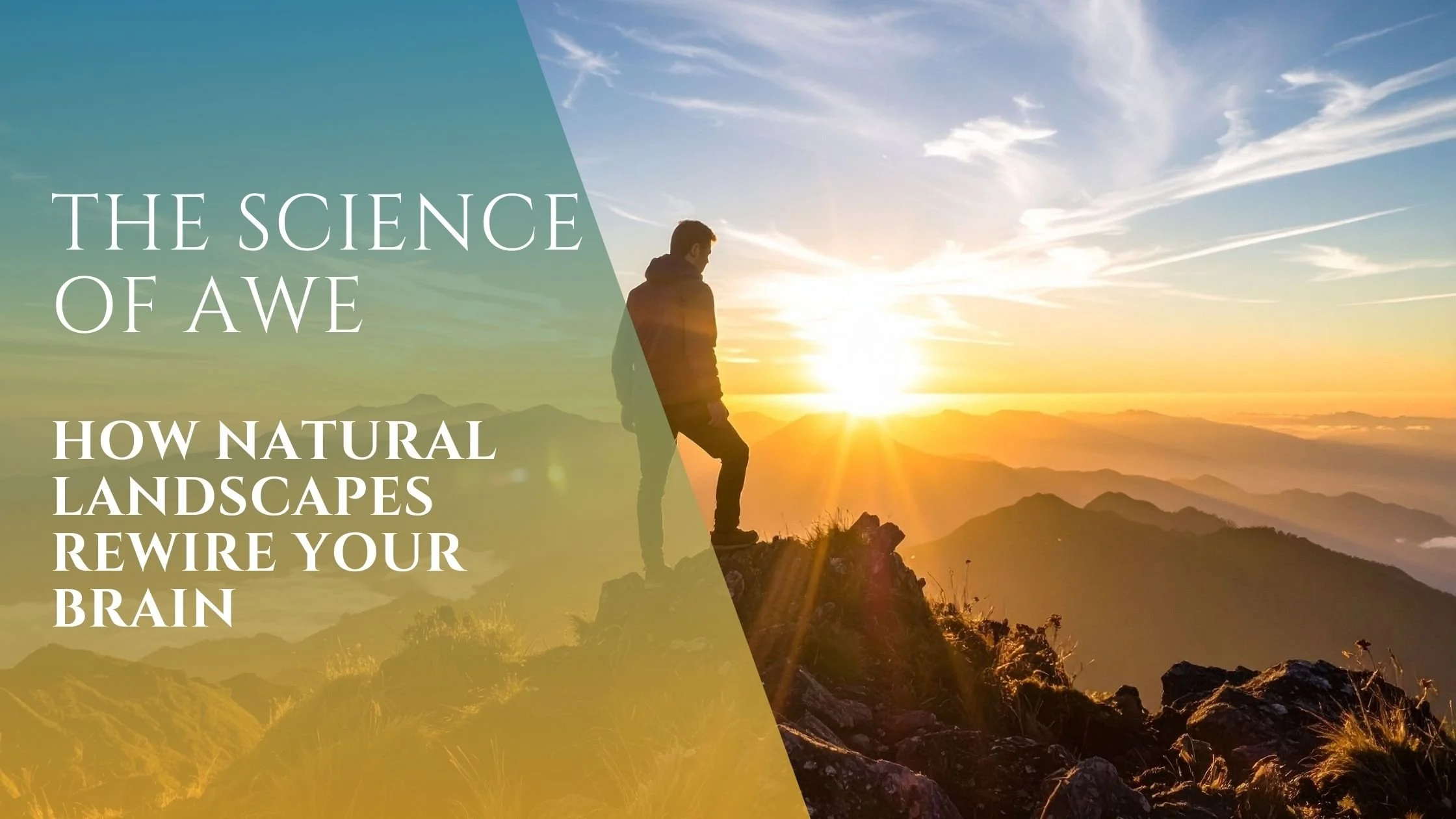
The Science of Awe: How Natural Landscapes Rewire Your Brain
Standing before Mount Warning at sunrise, watching light transform the landscape, something shifts inside you. Your breathing deepens. Your shoulders drop. The endless mental chatter quiets. This isn't just a pleasant experience—it's your brain undergoing measurable neurological changes. Welcome to the science of awe.
Defining Awe
Awe represents one of the most profound human emotions, typically triggered by encounters with vastness—physical, conceptual, or spiritual—that challenge our existing mental frameworks. Research published in Perspectives on Psychological Science describes awe as an experience that fundamentally alters how we perceive ourselves and our place in the world.
The Neuroscience of Awe
Groundbreaking research using fMRI technology has revealed what happens in our brains during awe experiences. A study published in Human Brain Mapping by researchers at the University of Amsterdam found that awe significantly reduces activity in the default mode network (DMN)—the brain network associated with self-referential thinking, worry, and mind-wandering.
This DMN quieting creates what psychologists call the "small self" effect. Dr. Dacher Keltner's research team at UC Berkeley found that awe experiences shift attention away from personal concerns and toward larger entities, diminishing the individual self in ways that paradoxically enhance well-being. Brain imaging studies show that this isn't merely subjective—it represents measurable changes in neural activation patterns.
Simultaneously, awe activates regions of the fronto-parietal network, particularly the insula, which is linked to bodily awareness and interoception. This dual effect—quieting self-focused rumination while enhancing present-moment awareness—creates the characteristic feeling of being transported outside oneself.
Awe and Health Outcomes
The physiological benefits extend far beyond momentary pleasure. Research published in Emotion found that among various positive emotions, awe most robustly predicted lower levels of pro-inflammatory cytokines, specifically interleukin-6. Chronic inflammation underlies numerous health conditions, from cardiovascular disease to depression. The awe-inflammation connection suggests that these experiences may have profound long-term health implications.
Studies have also found awe experiences associated with increased vagal tone—an indicator of parasympathetic nervous system activation and stress resilience. Research from Gordon et al. demonstrated that awe experiences (except threat-based awe) increase vagal activity, promoting the rest-and-digest state essential for healing and recovery.
Natural Landscapes as Awe Catalysts
While awe can arise from many sources—music, art, spiritual experiences—natural landscapes represent perhaps the most accessible and reliably awe-inspiring stimuli. Research examining diverse forest environments in Japan found consistent physiological benefits, including reduced cortisol, lower blood pressure, and decreased heart rate across different natural settings.
The Byron Bay hinterland, with its ancient volcanic landscapes, towering rainforests, and expansive vistas, provides ideal conditions for awe experiences. These environments offer what researchers call "perceptual vastness"—stimuli that exceed ordinary scale and complexity, triggering the cognitive accommodation that characterizes awe.
Duration and Dose
How long must you be immersed in nature to experience these benefits? Research provides specific guidance. The University of Michigan study found optimal cortisol reduction occurred with 20-30 minutes of nature exposure, though benefits continued to accrue beyond this threshold. For awe specifically, studies suggest that even brief encounters with vast landscapes can produce significant effects, though longer immersion deepens the experience.
The Integration Effect
Perhaps most remarkably, awe experiences don't just feel good in the moment—they catalyze lasting change. Research shows that awe enhances prosocial behavior, increases generosity, and promotes ethical decision-making. These effects persist because awe fundamentally shifts perspective, creating what psychologists call "accommodative processing"—the updating of mental schemas to incorporate new information.
Retreat environments amplify these benefits by providing repeated exposure to awe-inspiring landscapes, guided practices to enhance receptivity, and time for integration. Studies suggest that multiple awe experiences within a short period create compounding effects, strengthening new neural pathways and behavioral patterns.
Standing in the Byron Bay hinterland, watching the interplay of light and mist across ancient volcanic peaks, you're not just having a pleasant experience. You're engaging in what may be one of the most powerful forms of neurological medicine available—one that requires no prescription, produces no side effects, and reconnects you with the vast, awe-inspiring world we inhabit.
References:
van Elk, M., Karinen, A., Specker, E., Stamkou, E., & Baas, M. (2019). The neural correlates of the awe experience: Reduced default mode network activity during feelings of awe. Human Brain Mapping, 40(11), 3561-3574.
Keltner, D., & Haidt, J. (2003). Approaching awe, a moral, spiritual, and aesthetic emotion. Cognition and Emotion, 17(2), 297-314.
Stellar, J. E., John-Henderson, N., Anderson, C. L., Gordon, A. M., McNeil, G. D., & Keltner, D. (2015). Positive affect and markers of inflammation: Discrete positive emotions predict lower levels of inflammatory cytokines. Emotion, 15(2), 129-133.
Gordon, A. M., Stellar, J. E., Anderson, C. L., McNeil, G. D., Loew, D., & Keltner, D. (2017). The dark side of the sublime: Distinguishing a threat-based variant of awe. Journal of Personality and Social Psychology, 113(2), 310-328.
Bai, Y., Maruskin, L. A., Chen, S., Gordon, A. M., Stellar, J. E., McNeil, G. D., Peng, K., & Keltner, D. (2017). Awe, the diminished self, and collective engagement: Universals and cultural variations in the small self. Journal of Personality and Social Psychology, 113(2), 185-209.