

Beyond the Meditation Apps
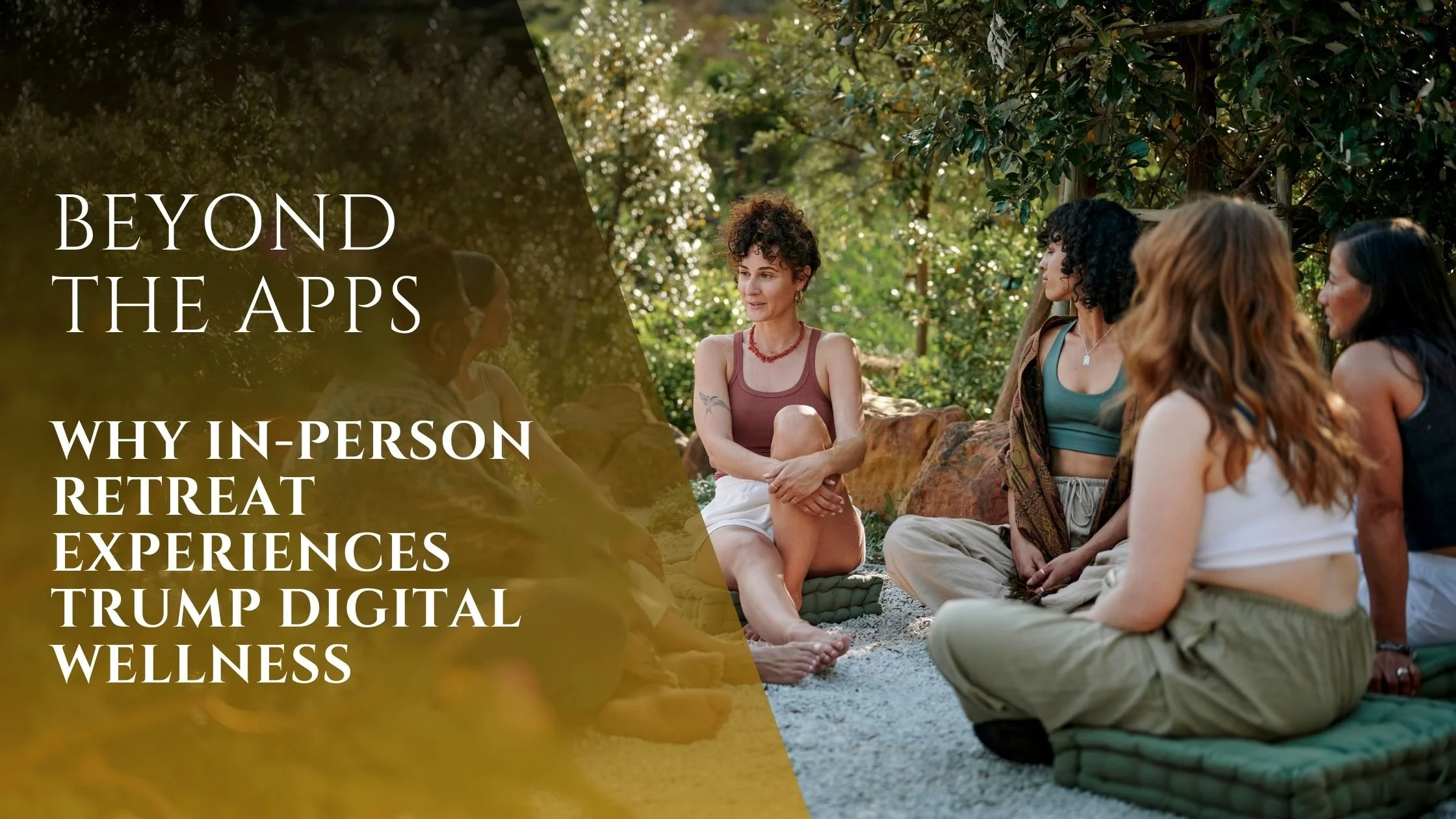
Why In-Person Retreat Experiences Trump Digital Wellness
Your meditation app sends you a gentle reminder: "Time for your daily mindfulness practice." You open it, half-listening while scrolling social media, then close it feeling vaguely guilty. Sound familiar? After years of promising to revolutionize wellness, digital health tools are leaving many people feeling more disconnected than ever. The solution might be surprisingly analog.
The Digital Wellness Fatigue
Wellness apps have become a multi-billion dollar industry, promising transformation through your smartphone. Yet research increasingly reveals their limitations. Digital interventions lack what neuroscientists call "embodied cognition"—the deep integration of physical sensation, environmental context, and lived experience that creates lasting change.
The polyvagal theory research published in Clinical Neuropsychiatry explains why apps fall short: your nervous system responds to environmental cues of safety, not pixels on a screen. No algorithm can replicate the physiological shift that occurs when you're physically removed from stressful environments and immersed in nature.
What Apps Can't Provide
Genuine disconnection: Using a device to disconnect from devices creates inherent contradiction. Research on digital detoxing shows that even having phones nearby—turned off—reduces cognitive capacity and increases stress. True nervous system regulation requires complete breaks from the technology that keeps us in constant sympathetic activation.
Sensory richness: Studies in Human Brain Mapping demonstrate that awe experiences—which activate specific neural networks and reduce default mode network activity—require perceptually vast stimuli. A guided meditation video cannot replicate standing beneath ancient trees or witnessing sunrise over mountains. The brain responds differently to genuine sensory immersion versus digital representations.
Co-regulation: Research on polyvagal theory emphasizes that humans are fundamentally social beings who regulate through connection. Video calls and text-based support groups cannot provide the neurophysiological benefits of in-person presence. Studies show that physical proximity, eye contact, and even synchronized breathing patterns create regulatory effects impossible through screens.
The Retreat Advantage
Research published in Frontiers in Psychology examining nature exposure found that participants experienced a 21.3% per hour drop in cortisol during in-person nature experiences. The key factor wasn't just "being outdoors"—it was the complete removal from digital connectivity and daily demands.
Retreat environments create what researchers call "restorative experiences" through multiple mechanisms. The temporary removal from decision-making demands (what psychologists term "directed attention fatigue") allows cognitive recovery. The natural environment provides "soft fascination"—stimuli that capture attention effortlessly, unlike the "hard fascination" of screens that requires effort to maintain focus.
The Embodiment Factor
Neuroscience research shows that learning and transformation occur through full-body experiences, not just cognitive understanding. You can watch a thousand videos about breathwork, but your nervous system only learns regulation through repeated practice in safe, supportive environments. Retreats provide embodied learning—practices witnessed, guided, and refined through in-person instruction that apps cannot replicate.
Studies on meditation practice reveal significant differences between app-guided and in-person instruction. Teacher presence allows real-time adjustment, response to subtle cues, and the transmission of what contemplative traditions call "presence"—qualities impossible to algorithmically generate.
The Integration Challenge
Perhaps most critically, apps fail at integration. Research shows that lasting behavioral change requires environmental support, social accountability, and repeated practice in varied contexts. Apps provide content but not context. Retreats create communities of practice where participants support each other's growth, share struggles, and witness transformation—powerful motivators that outlast any app notification.
As we face increasing digital overwhelm, perhaps the most radical wellness tool isn't the newest app—it's the courage to put our devices down entirely and remember that true healing happens in bodies, in nature, and in community.
References:
Porges, S. W. (2025). Polyvagal Theory: Current Status, Clinical Applications, and Future Directions. Clinical Neuropsychiatry, 22(3), 175-191.
van Elk, M., Karinen, A., Specker, E., Stamkou, E., & Baas, M. (2019). The neural correlates of the awe experience: Reduced default mode network activity during feelings of awe. Human Brain Mapping, 40(11), 3561-3574.
Hunter, M. R., Gillespie, B. W., & Chen, S. Y. (2019). Urban nature experiences reduce stress in the context of daily life based on salivary biomarkers. Frontiers in Psychology, 10, 722.
Ward, A. F., Duke, K., Gneezy, A., & Bos, M. W. (2017). Brain drain: The mere presence of one's own smartphone reduces available cognitive capacity. Journal of the Association for Consumer Research, 2(2), 140-154.